One can’t go to Mexico and not learn something about tequila, and to assure we learned enough, we did two day trips, one to the town of Tequila and to the Jose Cuervo tequila places, and the other was a Tequila Express First Class train trip. First, our trip to Tequila.
We headed out on a Charter Club bus again with Rosie as our guide. Here was our route:
As we got closer to Tequila, we began to see the blue agave plants everywhere, and they seemed to appear in every little bit of space we could see. More on that later, but here are a few of the agave fields.
 |
| The fields went up the mountain sides and were down in the valleys too |
 |
| And even in small spaces alongside the road. |
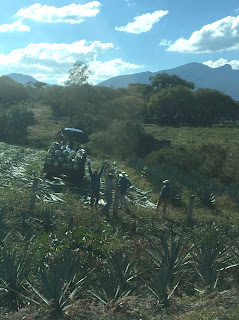
We were even fortunate to see a group of people harvesting the agave, and they were quite excited to have their picture taken.

One picturesque scene is Mt. Tequila, a volcano whose hardened core from its eruption 220,000 years ago rises from the middle of the mountain, a rare occurrence in geological history.
The eruption of this volcano creates soil that is conducive to the blue agave plant, which, by the way, is not a cactus, but is rather a succulent. FYI!
Another similar beverage is mezcal, but tequila is now a protected beverage which must be grown in this area and be certified (such as champagne), so if the bottle does not have a stamp and does not say 100% Agave, then don’t buy it. You are getting a cheap substitute.
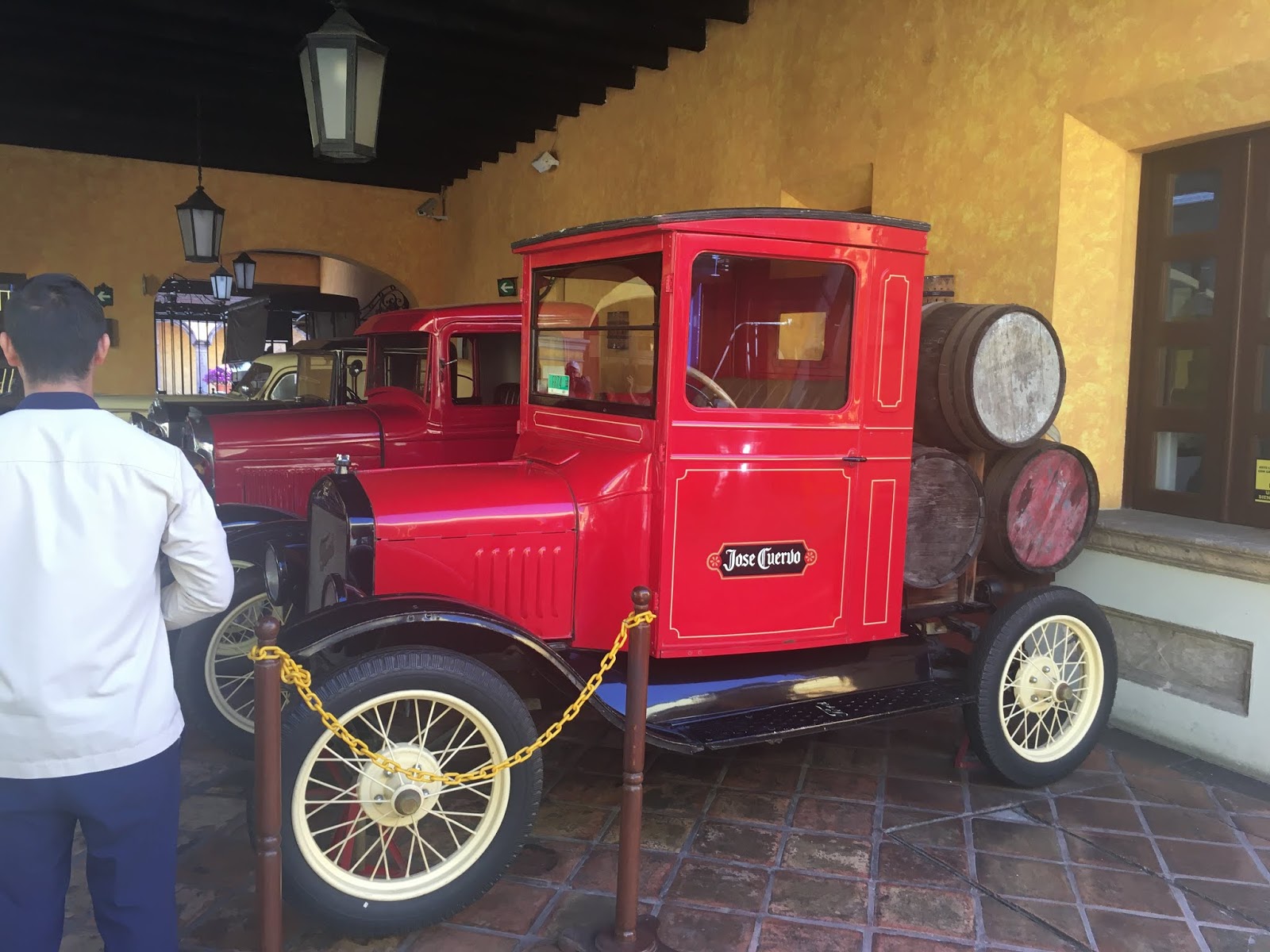
It was mass produced beginning in the early1800s, and in the last 18th century, José Guadalupe Cuervo received the first official concession to produce the tequila from the king of Spain. In 1860, it was first bottled, and now, everyone has seen a bottle of José Cuervo Tequila. More on that later.
Our first stop was at the Cuervo agave farm, and the growing process was described for us by none other than a Cuervo descendent, and if you’ve seen the recent Cuervo TV ad, he is in it.
The growth of the blue agave plant takes up to 10 years, but the farmers have figured out how to cut down the growth time to 7 years. Yes, it takes 7 years to grow one plant, and the plant, once harvested, is dead, so you have to start over again. To compound the difficulty, one agave plant doesn’t give you much liquid. You need thousands of them.
Each plant sends out suckers which are smaller plants that the farmers allow to grow reasonably large. Then these sucker plants are planted in the fields, and through a process of trimming of the leaves several times over the 7 years, the sucker is finally ready to be harvested itself.
 |
| The small sucker is removed from close to the base of the original plant |
 |
| The sucker, since it needs no water, can be tossed into a mound, and once the mound gets high, they plant the suckers in a new field. |
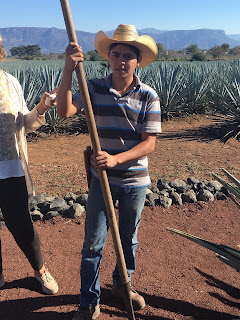 |
| The Cuervo descendent who was our guide |
 |
| He sharpened his blade to get ready for a trimming. First, the plant is trimmed into a tree like shape. Next time it is trimmed, it is more like a ball. They do this so the worms which can get into the leaves, do not spread into the heart of the plant. |
 |
| This little brown dot is a worm hole — evidence of the worm eating its way into the base (The reason why they cut off the tips of the leaves during the growing process) |
 |
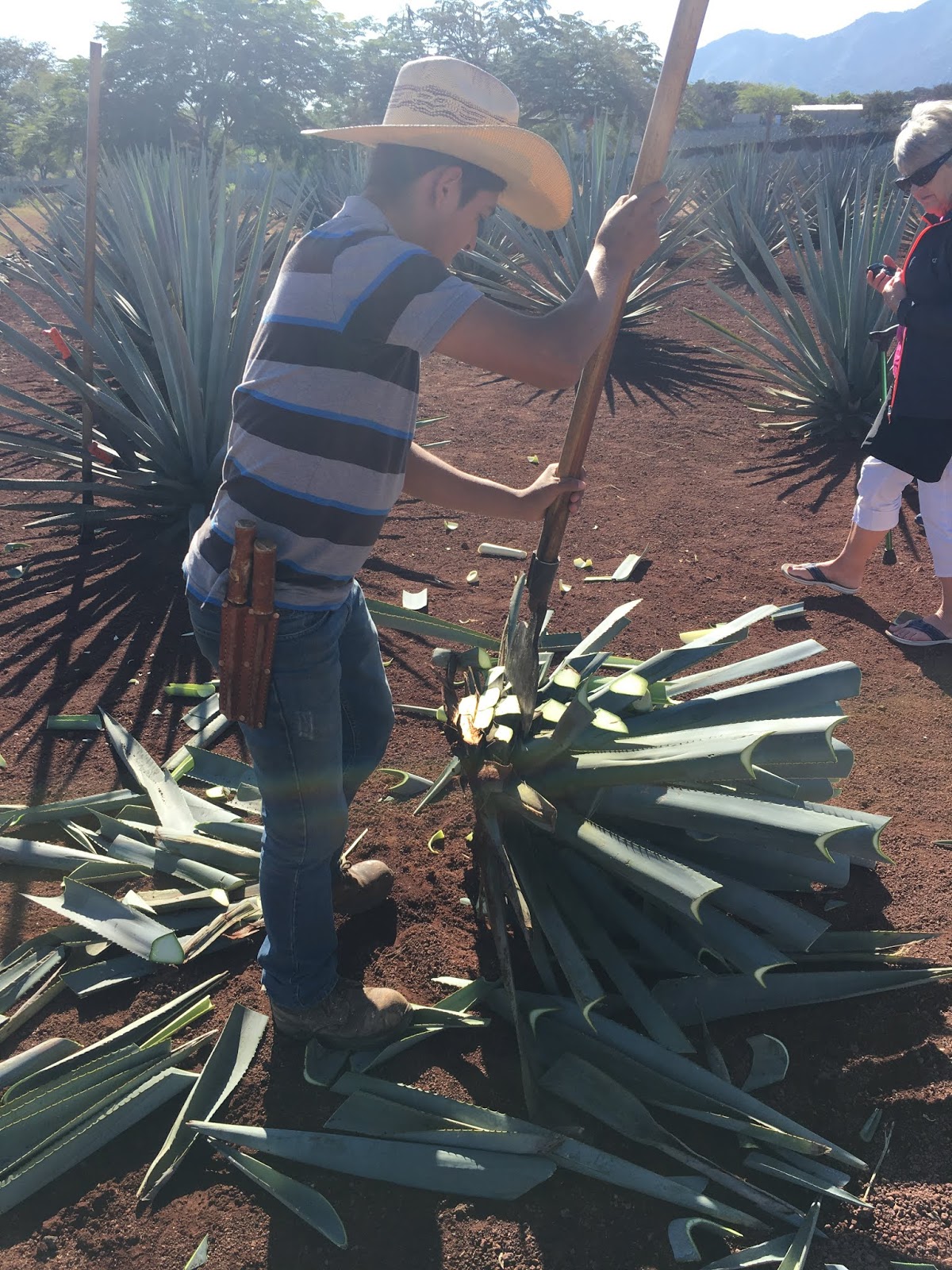
| When ready for harvest, the leaves are whacked off by hand. |
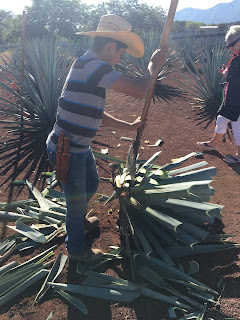 |
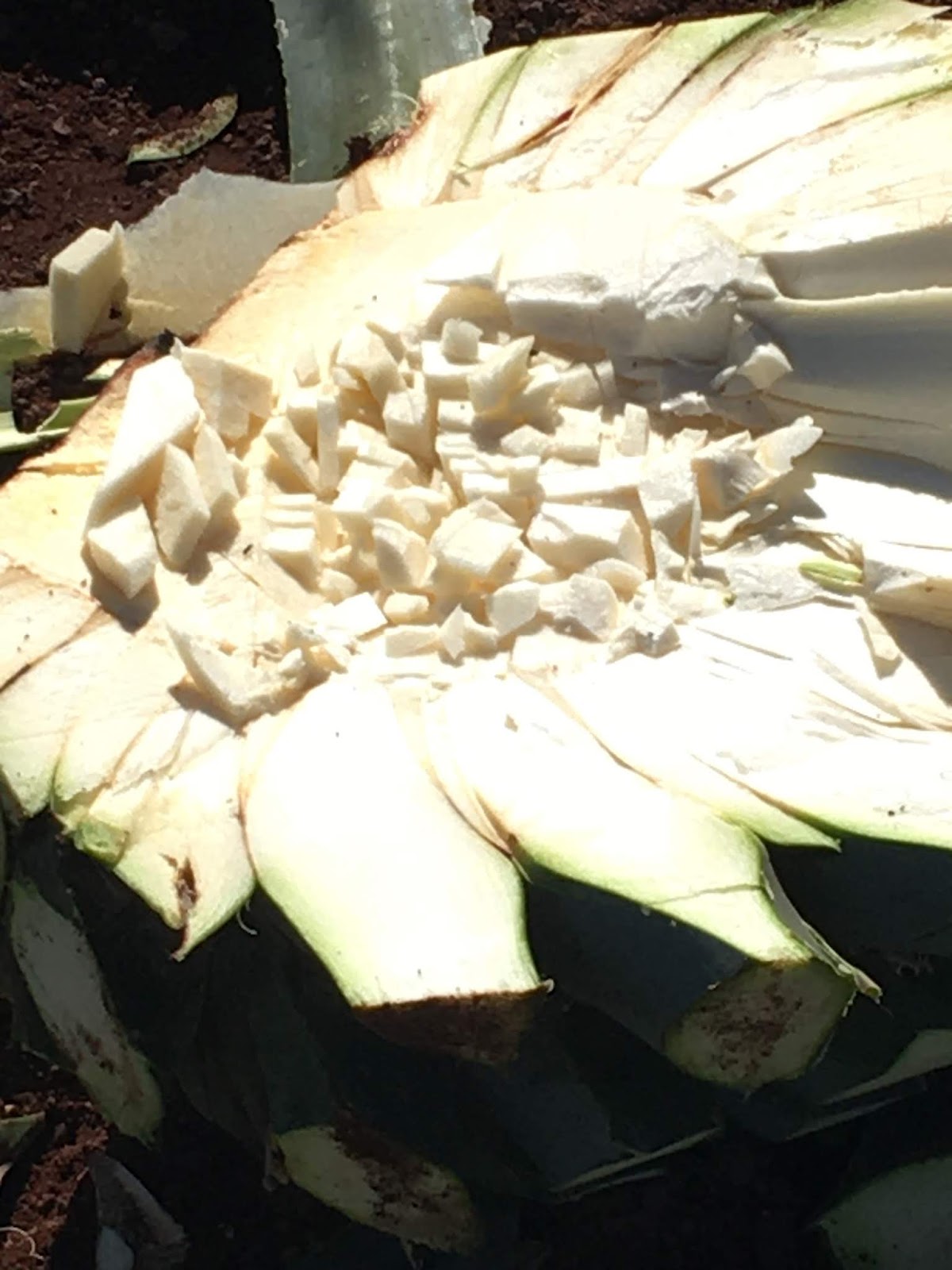
| And then the ball (no real root system) is trimmed neatly. The more expensive tequilas use only the material from the ball; cheaper ones can use a bit of the stems too. |
 |
| Here is a neatly trimmed ball. Note that it looks much like a pineapple. |
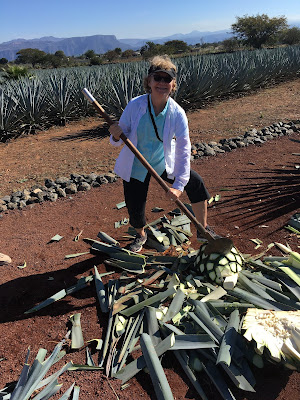 |
| Julie worked hard on the trimming. Well, sort of. She did pose for the picture :-). |
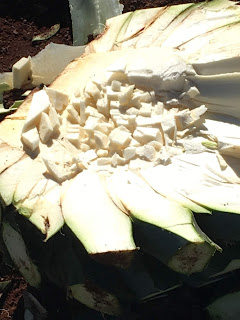 |
| We had a taste of the core of the plant. Tasted very bland and chewy. |
After our instructional session at the farm, we headed into the town of Tequila to visit the Jose Cuervo distillery, which wasn’t in production at the time. Actually, they were building their own distillery on their land where we were in the fields, and we saw several concrete trucks rolling past to get to the new distillery site. BTW, there are over 600 brands of Tequila in Mexico. Cuervo is the largest of them.
The distillery was huge, and the process is complex, so I’m not going to attempt to reproduce it here, but here are some pictures of the mechanical contraptions within the distillery:
 |
| The ovens |
 |
| The distilling process vats |
 |
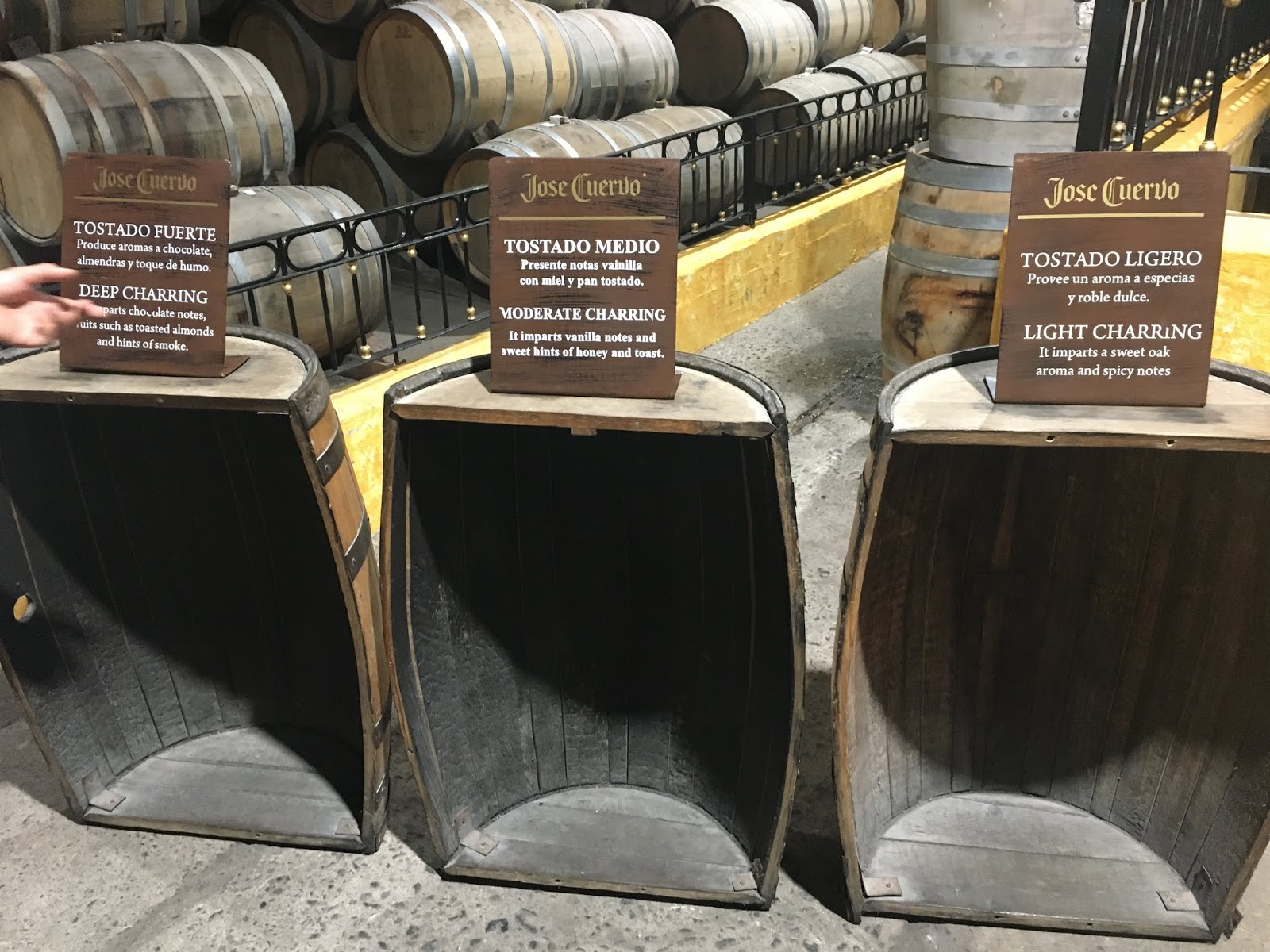
| Some of it goes into white oak barrels for 1 month to a number of years., depending upon quality wanted. |
 |
| The various tequilas the Cuervo distillery makes, from cheapest (on right) to most expensive (on left) |
 |
| Three different kinds of charring inside the barrels, with each one providing a different flavor |
At the end of the process, you could see the chemists at work assuring quality for the products
An added benefit — we got to go down into the cellars where the Cuervo family reserves are held. It was a huge stone room with tequila going back to the 1800s. It also included all the artistic boxes they are currently using for each year’s new product.
 |
| The descent. . . . |
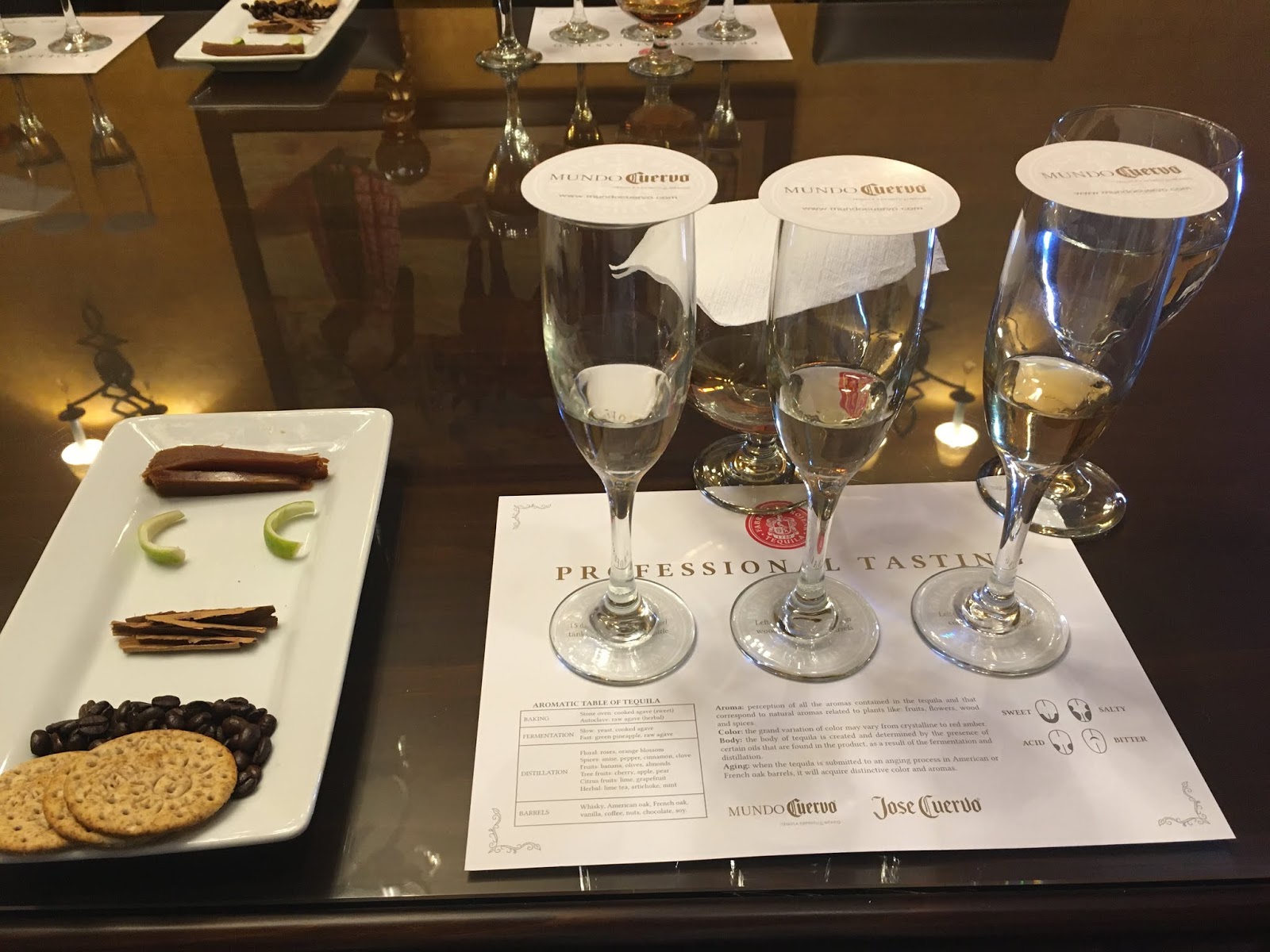
We did one more thing at the distillery — a professional tequila tasting, the subject of another blog posting.
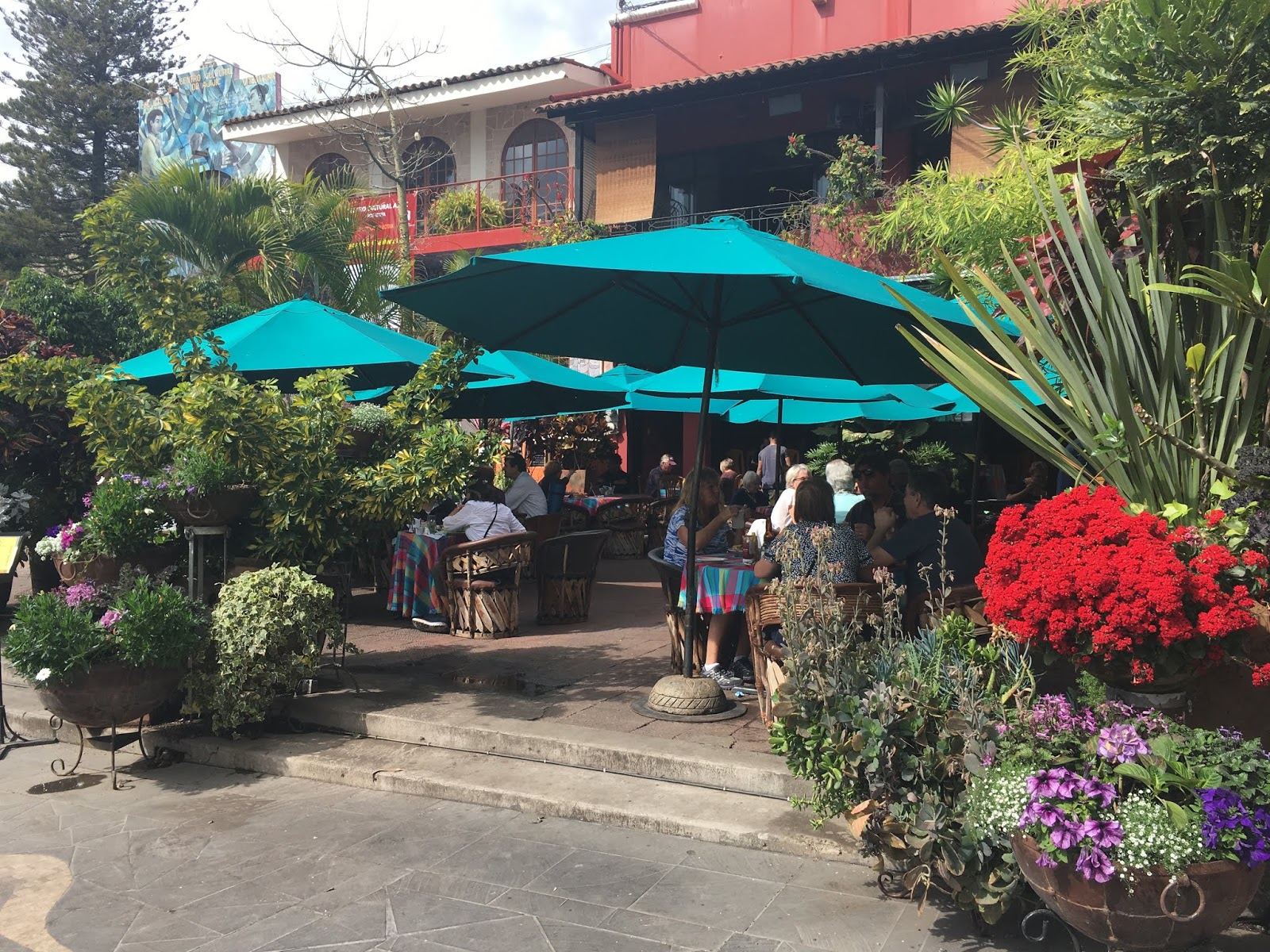
The other adventure for the day was to amble around the town plaza in Tequila, see the shops, have lunch, and generally just enjoy the beautiful day. Tequila is another one of Mexico’s magic towns (a designation for cities of historical or cultural or social significance) and it is also a UNESCO heritage site. They are working on updating the exteriors of the buildings to make it more of a tourist attraction. It is a pretty city.
 |
| All the towns have this type of name plate at some prominent location within the community, probably the towns in the state of Jalisco |
 |
| Cuervo means “raven” FYI |
 |
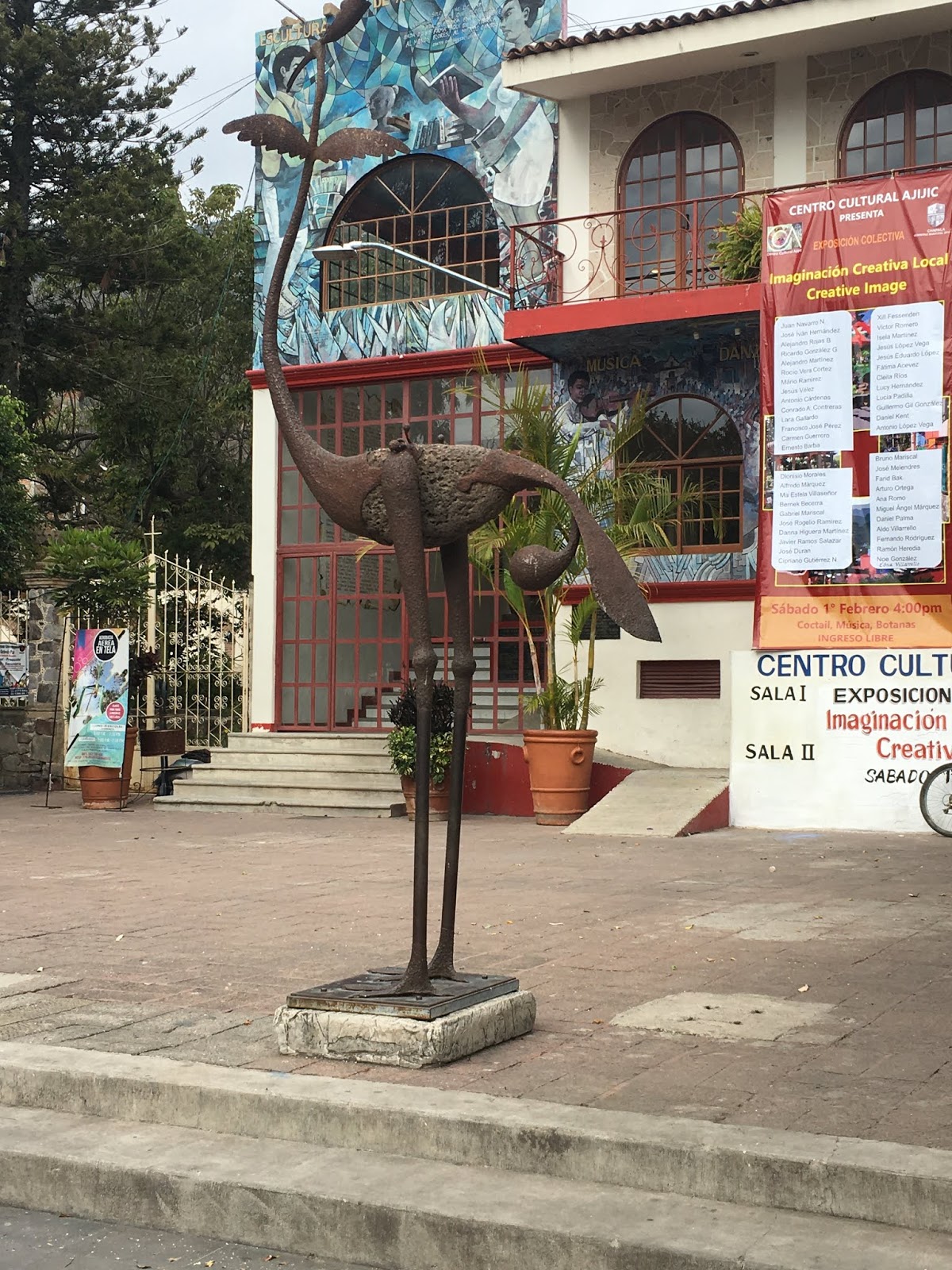
| Lots of historical sculptures in the town square |
 |
| And real Mexican vaqueros (Maybe real) |
 |
| Every town square must have a church |
 |
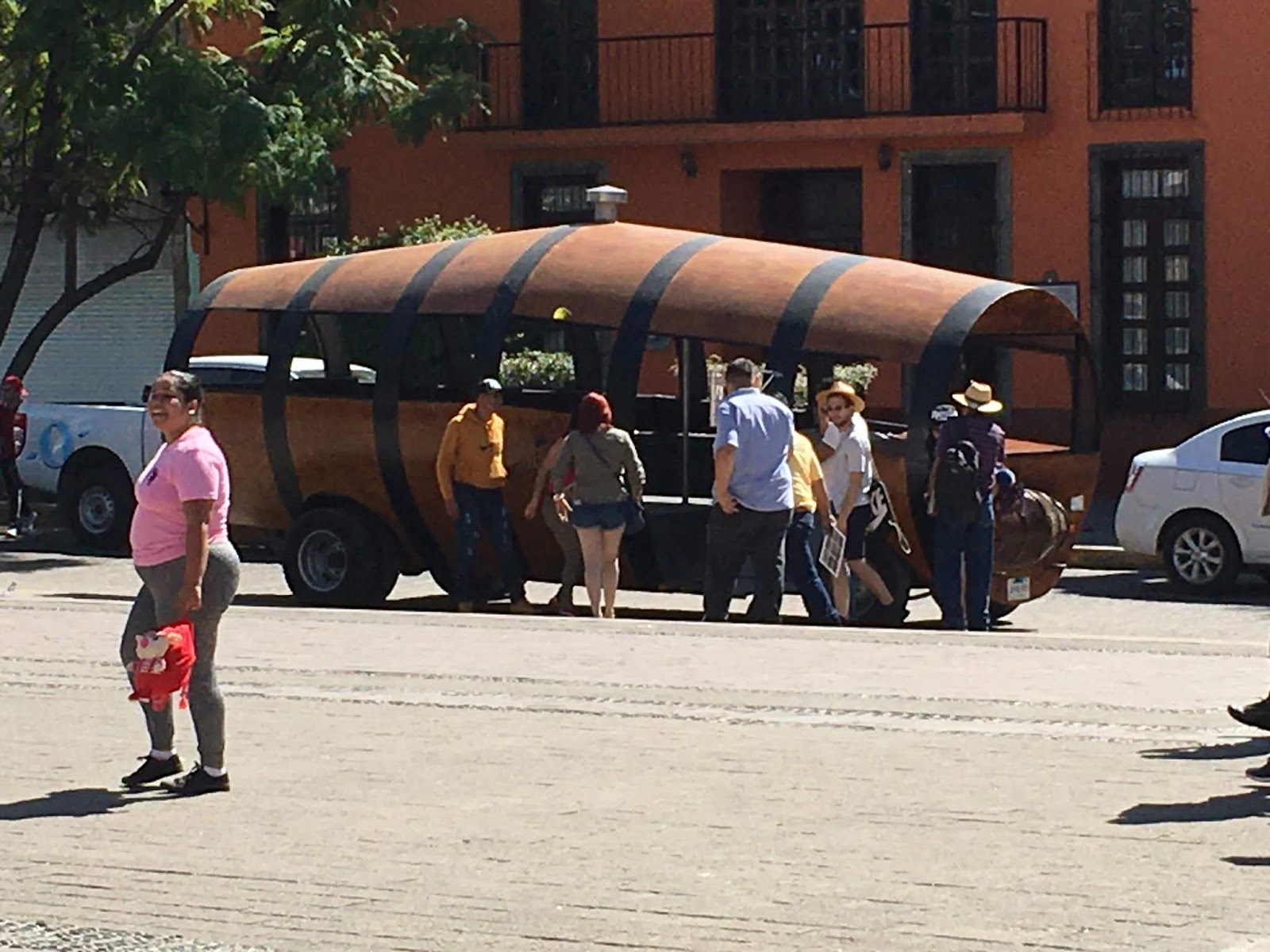
| And this one also has a tequila barrel tourist vehicle. |