Another Ajijic Charter Club tour day, this time to an ancient archeological site. Every time we visit one of these sites (and we have now been to several in Ecuador, Peru, Guatemala, and Mexico), we become more amazed at the advanced societies that thrived thousands of years ago. The site we visited today — by the village of Teuchitlán and called Guachimontones for the Guaje trees that grow there — was equally impressive.
We’ll discuss three aspects of the tour: (1) the society and the irrigation techniques used to grow food in chinampas, (2) the overall site with its round pyramid and the religious significance of it, and (3) the ball court at the site. And we’ll toss in a few other tidbits too.
First, there were 10 of us on the tour, along with our guide, Herman. He was our guide for another one of our trips too (Mazamitla), and while not the best guide in the world, he was okay. We took the two-hour trip (on the other side of Guadalajara) to the village of Teuchitlán where the archeological site is located. The most adventuresome part of the journey was that we took a short cut road from one highway to another, and the dirt path was muddy, one-vehicle wide, and in some places filled with water from the previous rain. We did, however, get to see sugar cane plants up close — really close.
 |
| On our short cut, we actually drove through this water on the way there |
 |
| We did meet a few vehicles. Fortunately, there were spots where people could pull their cars over. |
 |
| This sugar cane was about ready to be burned and then harvested. The burning gets rid of the dead leaves and also rids the area of the rattlesnakes and coral snakes that lurk in the fields. |
The village is small, and from we could tell, there was one small touristy-type shop (no, we didn’t stop).
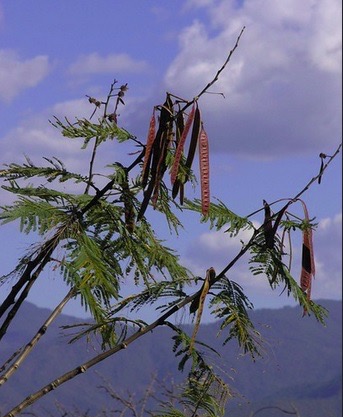
We went directly to the site named for the number of Guaje trees on the site, the one that has the long red bean-like pods with the beans inside. We have tasted them before, and they are quite good, and are especially good when roasted.
Phil Weigand was the archeologist from the University of Arkansas who “discovered” and worked on the site for 40 years (he died in 2011), establishing its traditions and recreating the culture from the evidence in the area, called the “Teuchitlán tradition” by Weigand. There is evidence of this tradition as early as 1000 BCE and it seems to have been replaced by around 500 AD, with the tradition flourishing from around 100 BCE to 350 AD with a potential population of around 40,000 people.
(1) CULTIVATION METHODS: It seems these indigenous people came because of the lake and the amount of water in the area, a plus in the development of the “chinampa” method of cultivation they used. In this method, they built up a massive number of large rectangular dirt squares surrounded by the water where they would grow corn and whatever else they needed. The water was also a source of fish, and it was most likely a culture that fared well for nutrition. These pictures came from the excellent museum on site, both from the photo descriptions and from the video.


(2) RELIGIOUS SIGNIFICANCE OF THE MOUNDS: Beyond developing excellent methods of growing food, they also cultivated the site as a religious center. The unique aspect of the site is that the tiered structures here are circular, not square as in many other locations. There are two large circles that have been reconstructed according to the archeological evidence (The Great Guachi and The Iguana) and between the two is an elongated ball court, thought to be the largest court anywhere in Mesoamerica. The third mound has no been recreated so we were able to climb up to the top and view the entire area from on high. Circle 1 includes 12 platforms and is 125 meters across; circle 2 is 115 meters across and is surrounded by 10 evenly-spaced platforms which would have been the base for perishable buildings, perhaps covered by a thick layer of clay painted plaster. The space between the 10 platforms and the circle was probably used for religious dancing.


 |
| A recreation of the dancing that would have been done between the mound and the platforms. |
 |
| That’s the two of us with the Iguana Circle to our left and Mt. Tequila (a volcano) to the right in the background. |
 |
| One of the platforms for the 10 equally-spaced buildings around the circle |
 |
| This is the third mound which has not been reconstructed. We were able to walk up a little path to the top. Stunning views. |
 |
| The view from the top |
These circles also had deep holes in the top that are suspected to be post holes; thus the ceremonies would have included a Flying Ritual in which a priest, tethered to the top, would simulate flight during ceremonies.
(3). THE BALL COURT: Between the two large mounds is one of two ball courts on the site, and one of the courts is the largest ever found in Meso-America. In this, the oldest ball game in MesoAmerica, players would hit the ball with their shoulders or their hips, and the game would often last all day. To say “game,” however, is a bit of a misnomer because often, the winner was deemed to be chosen by the gods; thus, the loser would die. Several of the bones found in the area indicate broken hips in the males. Doesn’t sound like much fun! Spectators, however, would watch, and presumably cheer, from the “stands” along the sides of the court.
 |
| The steps on the sides is where the spectators would sit |
The museum itself was excellent and was shaped in the circular form of the mounds. We started with a video, and then moved on to several of the exhibitions. Some of the pictures from above were in the museum. There was also a recreation of a tomb.
 |
| Multiple architectural aspects of the building, both inside and out, are recreations of the circles themselves |
 |
| A tomb found on site |
Another notable fact of the area is that it contains the third largest deposit of obsidian anywhere in the world. This volcanic rock would have been important for making arrowheads and other implements to improve their lives, including jewelry.
After visiting the site, we went to a delightful little lake-side restaurant, with the lake so close that it was actually encroaching on the restaurant floor. The specialty of the house was frog-legs from frogs in the lake. Julie enjoyed these huge delicacies which tasted sort of like — well, chicken.
We were all tired and did some sleeping on the way home. It was a good day with beautiful weather after a rather chilly few days.